
Melina G. Luethje, PhD
I am an interdisciplinary geoscientist interested in understanding lake dynamics on varying spatial and temporal scales. In other words, I am a paleolimnologist, or someone who studies past lakes. To do this, I use diatoms, a type of photosynthetic algae with glass shells, to reconstruct past lake environments. Changes in lake environments through time can be caused by regional factors (e.g. climate) or local factors (e.g. human land-use). My research aims to tease apart what caused past changes in lake environments to provide insight into modern and future lake environmental shifts. I am currently seeking employment using my skills to either continue researching/teaching or to monitor water quality in a laboratory setting.
Ph.D. Evaluating the resilience of Andean lakes to climatic and anthropogenic impacts on varying spatial and temporal scales
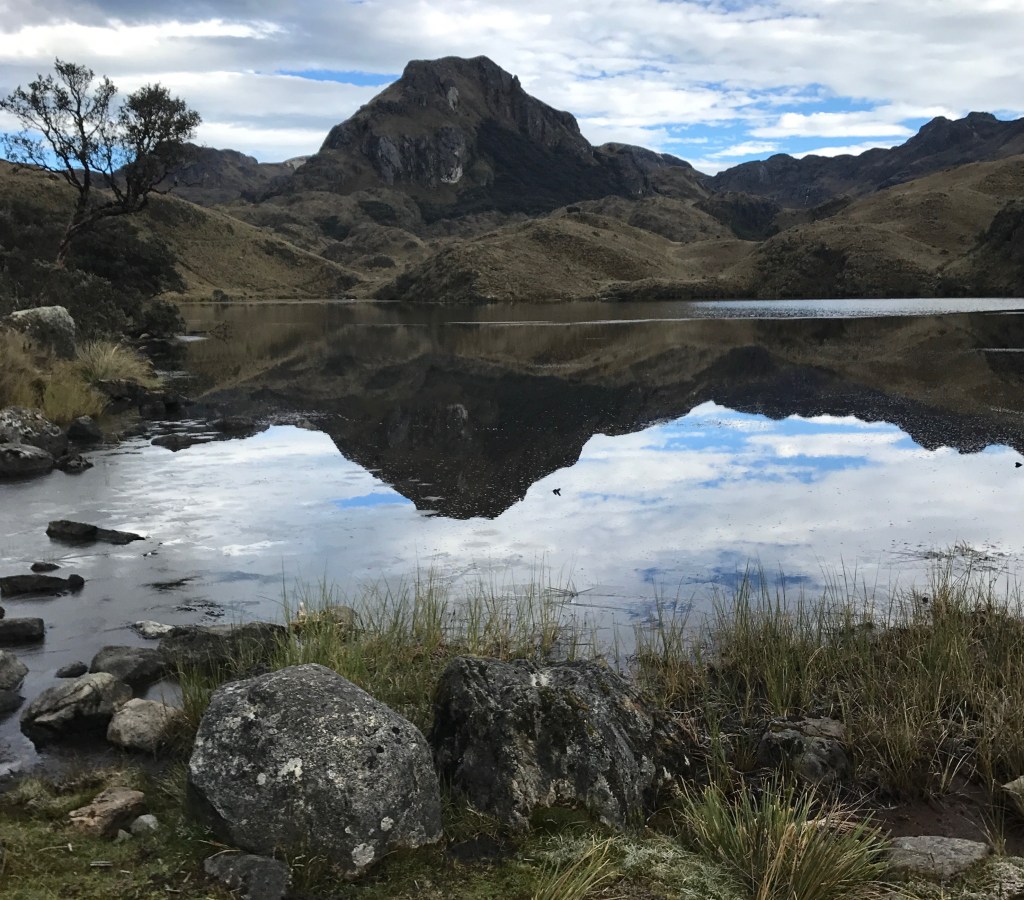
Contemporary and fossil diatoms were used to investigate Andean lake response and resilience to climatic and anthropogenic impacts on varying spatial and temporal scales. Main takeaways:
- Lakes on the interandean plateau differ from those on the Andean plateau in their diatom community and lake characteristics.
- In 2017, a subset of Ecuadorian Andean lakes sampled in the 1980s was resampled for diatoms. Diatom species composition did not change substantially, highlighting lake resilience
- Diatom species composition and geochemical variables were analyzed from two lake sediment cores spanning the last 2,500 years to test whether northern and southern Ecuadorian lakes respond to regional (e.g. climatic) or local (e.g. land-use) changes. The lakes didn’t respond to the same changes suggesting complex dynamics in the Andes.
- Fossil diatoms, fossil pollen, geochemistry, and sedimentology were used to evaluate the paleoenvironment of a 5.4 million year old paleo-lake outcrop. We found that the Chilean Andes were likely wetter than present day in the early Pliocene.
M.S. Investigation of diatom endemism and species response to climate events using examples from the genera Cyclotella (Lindavia) and Surirella in the Lake El’gygytgyn sediment record

I did a detailed investigation of diatom morphology using scanning electron and light microscopy (SEM and LM). Paying great attention to detail I observed changes in valve morphology over time, and connected these changes to known climate events in the Lake El’gygytgyn. Main takeaways:
- Changes in morphology in the genus now known as Lindavia or Pantocsekiella were associated with extreme cold events in the lake.
- A new species of Pantocsekiella unique to the lake persisted during a time of relative climatic stability, allowing valve size to increase, out competing other large-valved planktic diatoms.
- Changes in Surirella morphology were not associated with climate events.
 Melina Luethje